
In the world of Titan Analysis, we don’t look for the next “disruptor”—we look for the company that is impossible to displace. As we scan the market for candidates to fit our 5-Tier Resilience Strategy, few names command as much respect as Visa Inc. ($V).
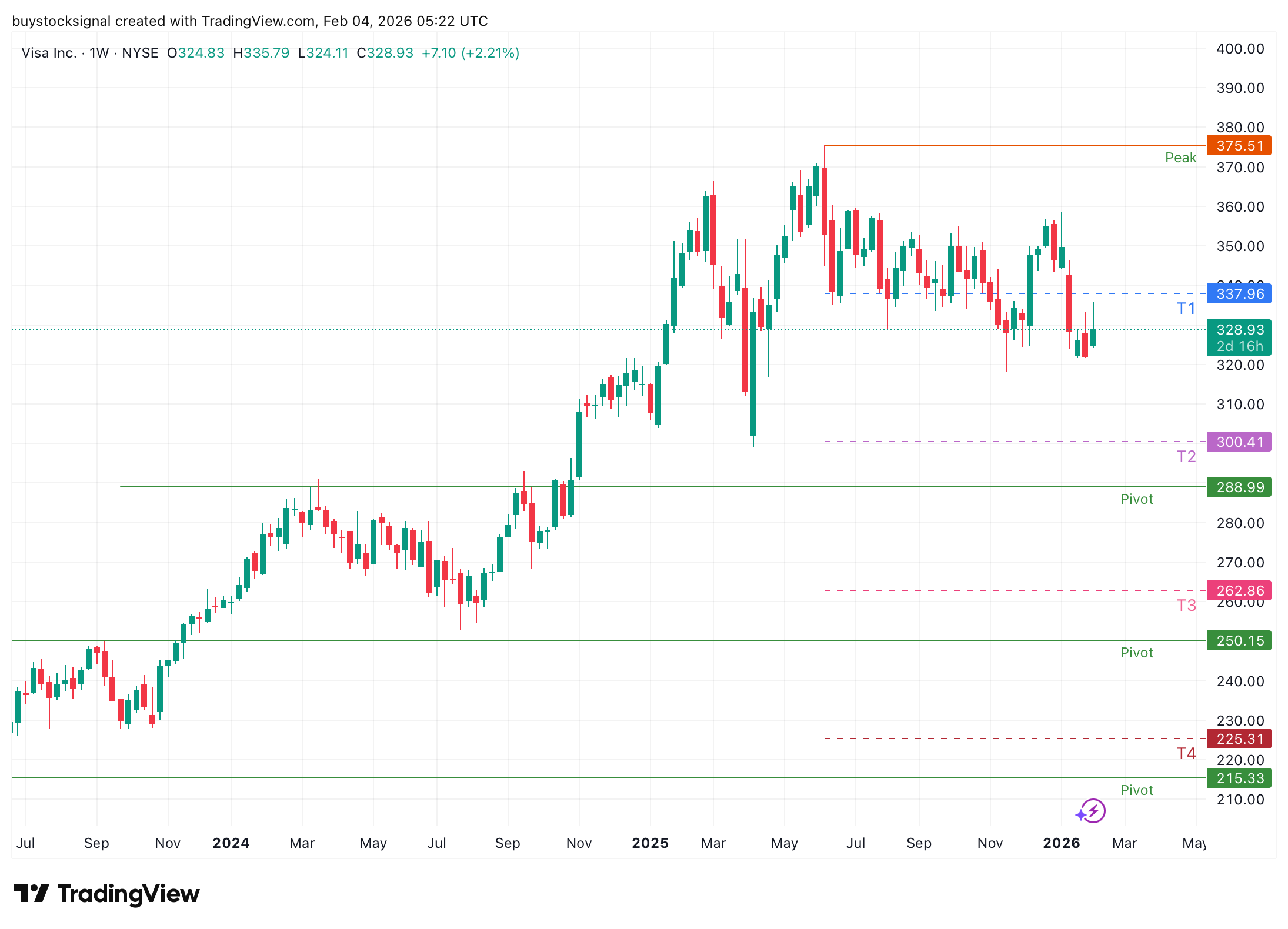
This week, Visa has officially moved into our crosshairs. Following a period of broad market consolidation and shifting sentiment in the fintech sector, Visa has retraced from its All-Time High (ATH) of $375.51. With the current price sitting at $328.93, the “Master Blueprint” has been triggered.
Part I: Why Visa? The Anatomy of a Titan
Before we look at the numbers, we must justify why Visa belongs in a “Resilience” portfolio. Our strategy requires a company to be more than just “big”; it must be a Titan. Visa earns this title through three specific structural advantages:
1. The Toll-Bridge Moat
Visa does not lend money. Unlike banks, they carry no credit risk. They are a pure-play technology network—a digital “toll bridge” that collects a small fee every time someone taps a card or clicks “buy” online. Whether the economy is booming or inflating, people must spend. Visa’s take-rate on global consumption makes it one of the most efficient “inflation hedges” in existence.
2. Elite Margins and Cash Flow
A Titan must have the financial strength to survive a 50% stock price drop without breaking its business model. Visa boasts operating margins consistently north of 60% and a Return on Equity (ROE) that puts most of the S&P 500 to shame. This massive cash pile allows them to buy back shares and increase dividends even during market flushes.
3. The Network Effect
With billions of cards in circulation and millions of merchant locations, the barrier to entry for a competitor is nearly insurmountable. While “fintech” apps come and go, most of them still run on top of Visa’s rails. In our strategy, we bet on the rails, not the trains.
Part II: The 5-Tier Roadmap for Visa ($V)
To execute our strategy, we anchor all calculations to the Anchor Peak of $375.51. We do not guess where the bottom is; we let the math dictate our deployment.
| Tier | Pullback | Price Target | Capital Weight | Status |
| Peak | 0% | $375.51 | — | Anchor Point |
| Tier 1 | -10% | $337.96 | 15% | ACTIVE (Price Below Target) |
| Tier 2 | -20% | $300.41 | 25% | WATCHLIST |
| Tier 3 | -30% | $262.86 | 20% | Monitoring |
| Tier 4 | -40% | $225.31 | 20% | Monitoring |
| Tier 5 | -50% | $187.76 | 20% | Resilience Threshold |
Part III: Weekly Action – The Tier 1 Trigger
As of this writing, Visa is trading at $328.93.
Our Tier 1 Entry was mathematically set at $337.96. Because the current price is slightly below this level, we have officially moved into the “Starter Zone.”
The Current Move: Deploying the 15% Starter
For those following the Blueprint, this is the designated moment to deploy the first 15% of your allocated capital for Visa.
- The Psychology: Entering at $328.93 means we are already buying at a 12.4% discount from the peak. We aren’t worried that the stock isn’t at its ATH; we are satisfied that we have secured a “Titan” at a double-digit discount.
- The “Wait and See”: We do not chase the price. If Visa rallies from here back to $375, we have our 15% starter position working for us. If it continues to drop, we simply wait for our next strike zone.
Part IV: Preparing for the Tier 2 “Heavy Load”
The beauty of the 5-Tier Strategy is the removal of stress. If Visa’s price continues to slide toward $300.41 (Tier 2), we don’t view it as a loss; we view it as an opportunity to deploy our largest capital slice: 25%.
Why Tier 2 is Critical
Statistically, high-quality Titans like Visa often find a “valuation floor” at the 20% correction mark. This is where institutional “Value Hunters” typically step in. By placing 25% of our capital here, we significantly lower our average cost basis.
The Math of the Average:
- If you buy 15% at $337 and 25% at $300, your weighted average price becomes $313.87.
- Suddenly, you only need Visa to return to $314 to be in the green, even though the stock is still 16% below its all-time high. This is the essence of Mean Reversion Scaling.
Part V: Harvesting Volatility – The Tier-Swap Outlook
Looking ahead to next week, we are already setting our “Harvest Targets.”
If we fill our Tier 1 position at the current price and the market experiences a relief rally back toward $355 – $360, we hold our core. However, if the stock drops to Tier 2 ($300) and then bounces back to Tier 1 ($337), we will execute the Tier-Swap Rule.
The “Ping-Pong” Plan:
- Buy Tier 2 at $300.41.
- Sell the Tier 2 lot when it hits $337.96.
- Result: A quick 12.5% profit on 25% of your capital, while your original Tier 1 shares continue to hold for the long term.
This allows us to generate cash flow even if Visa spends the next six months trending sideways.
Conclusion: Discipline Over Prediction
Visa is the perfect example of why we use the 5-Tier Strategy. It is a stock that everyone wants to own, but few have the discipline to buy correctly. By ignoring the daily financial news noise and focusing on our Weighted Capital Allocation, we are building a position in a global monopoly at prices dictated by math, not emotion.
We are currently Long Visa at Tier 1. We are standing by with 25% of our capital to strike at Tier 2 ($300.41).
Stay disciplined. Trust the Tiers.
Investment Disclaimer: This analysis is for educational and informational purposes only. Trading “Titan” stocks and scaling into declining markets involves significant risk. Past performance is not indicative of future results. I am not a financial advisor. Please perform your own due diligence or consult a certified financial professional before making any investment decisions.